
In a world today, democracy must evolve to meet challenges that elections and institutions alone cannot solve. This article explores how reordering our priorities from the planetary to the personal, might lead to a deeper and more ethical approach to democratic governance. After all, beneath our political differences lies a fairly simple expectation: people want to live decent, dignified lives, and they want a system of governance capable of helping make that possible.
A note on scope: I was born in a democracy and continue to live in one, so democracy is the system I know and the lens through which I explore these ideas. This article does not attempt to determine whether democracy is universally the best form of government. Its underlying question is broader: what principles should guide any system of governance if flourishing of all beings, is its ultimate purpose?
Phase 1: The Journey of an Idea
I often ask myself , how can democracy be harnessed to elevate humanity collectively, moving beyond narrow self-interest toward genuine global flourishing? The power inherent in democracy can undoubtedly reshape societies, but current iterations have yet to fulfil their promise.
To genuinely transform democracy into a tool for global betterment, we must critically assess its imperfections and envision a refined, inclusive model.
The Limits of Democracy: Historical to Modern Reflections
Throughout history, democracy has oscillated between inspiration and disillusionment. Originating in ancient Athens around the fifth century BC, democracy promised “rule by the people,” yet excluded vast sections of the population, including women, enslaved people, and non-citizens.
Thinkers such as Plato questioned whether ordinary citizens were sufficiently informed and equipped to make sound political decisions, fearing that democracy could become vulnerable to demagoguery and emotionally driven judgement.
Centuries later, the American and French Revolutions expanded democratic ideals while revealing contradictions of their own. Thomas Jefferson’s declaration that “all men are created equal,” for instance, stood in stark contrast to the reality that Jefferson and his contemporaries themshelves enslaved other human beings. Democracy continued to evolve, but the gap between its ideals and its practice remained.
Today, one of democracy’s challenges has taken a different form and the problem may be less about a scarcity of information than our ability to navigate its abundance.
The internet has given citizens access to more information, perspectives, and political discourse than earlier generations could have imagined, yet greater access does not necessarily produce a better-informed public. Social-media platforms increasingly mediate what people encounter through algorithms that select and prioritise content, often giving emotionally charged, partisan, misleading, or repetitive material disproportionate attention.
The result is a strange democratic paradox: citizens can be surrounded by information while still struggling to determine what is reliable, relevant, or true.
This matters because the same digital networks that democratise access to information can also accelerate misinformation, deepen existing divisions, and mobilise people at extraordinary speed. They can help citizens organise legitimate protests and challenge entrenched power, but can also be exploited to manipulate public opinion, inflame tensions, and distort political reality.
The problem, then, is no longer simply whether citizens have access to information, but whether they have the time, tools, and willingness to critically evaluate what reaches them before acting upon it.
A Fragile Ideal: Lessons from the Middle East
As I mentioned at the beginning, I live in a democracy, yet democracy, for all its promises, is not a universal fix, and we have seen attempts at its forced imposition contribute to the unravelling of entire nations.
Democratic form without ethical, social, and institutional foundations can prove dangerously fragile.
The disintegration of Iraq following Saddam Hussein’s fall, the fragmentation of Libya after Gaddafi, and the prolonged devastation of Syria offer different but related warnings. These are not simply failures of movements seeking greater freedom, but also failures to understand what happens when existing political structures collapse without viable institutions ready to replace them.
The resulting vacuums can fuel extremism and instability while creating opportunities for regional and international powers to pursue their own interests. Whether Western interventions were driven by democratic ideals, strategic self-interest, or a combination of both, the consequences have often included broken institutions, fractured societies, and generations shaped by conflict.
These experiences therefore raise a sobering question: can a one-size-fits-all model of democracy truly serve the vastly different realities of every nation?
The Real Problem: Ethics, Not Systems
All governance systems, whether authoritarian, democratic or everything in between are prone to corruption when divorced from ethics and morality and looking at the heart of the world’s crises is not a flawed constitution or a broken policy, but a lack of moral imagination, of ecological humility, of collective empathy. We see the world through narrow, self-serving lenses and we act not as stewards but as conquerors.
Yet, democracy remains one of the few systems that allow space for critique, reform, and reinvention and its strength lies not in perfection, but in its capacity to evolve. What we need now is a deeper reform, not just in structure, but in consciousness.
Pain Points in Modern Democracy
Contemporary democracies are designed to be open and inclusive. But this openness invites manipulation and several vulnerabilities have emerged over the years:
Lobbying and Corporate Capture: Wealthy interest groups shape policy not for the public good, but for profit.
Media and Academic Manipulation: Economic pressures and foreign influence turn newsrooms and classrooms into echo chambers.
Superficial Participation: Voter apathy, misinformation, and media bubbles dilute the democratic process into performance.
Democracy today risks becoming a theatre, one where actors change, but the script remains the same.
The Pyramid of Priorities
At the top of this pyramid is the individual where most leaders place their attention and from there, their priorities expand only slightly: family, community, nation, allies?
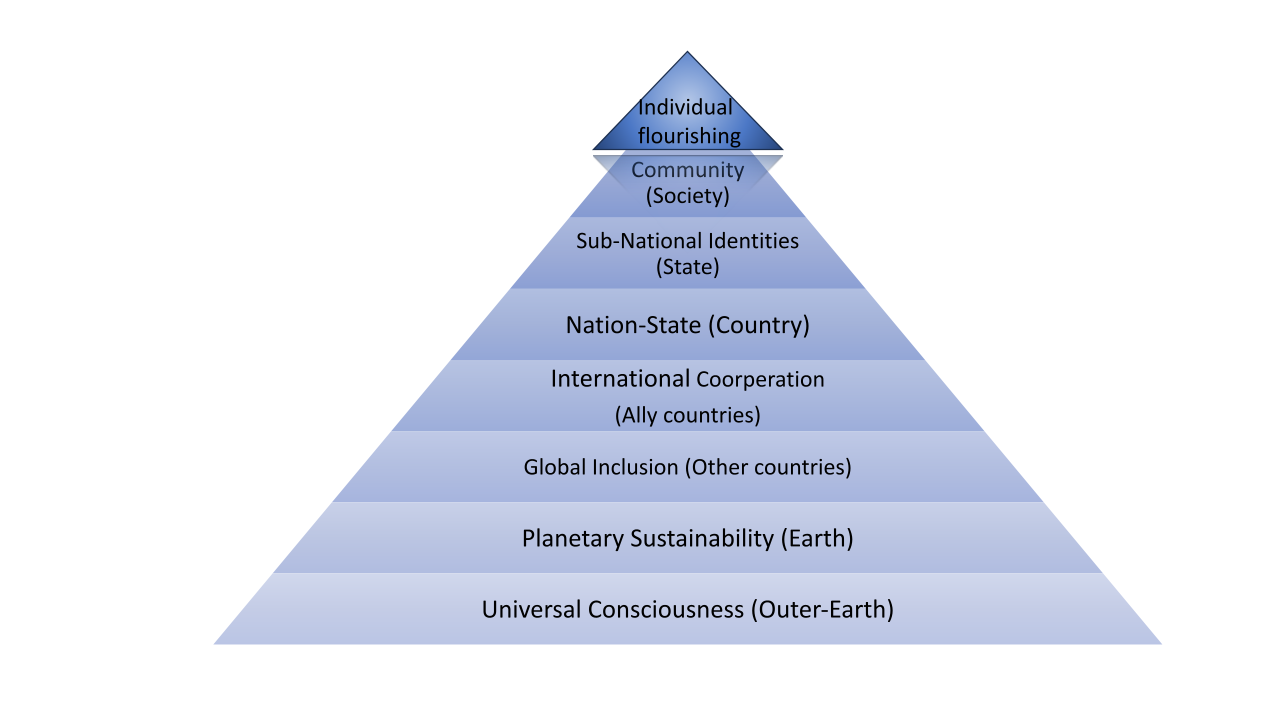
A conventional hierarchy of priorities where individual and national interests dominate, while planetary and universal concerns remain peripheral.
But the further one moves toward planetary or universal concerns, the fuzzier and less important, those priorities become in political calculus.
This is what I call the inside-out worldview.
But what if we flipped it?
In the centuries to come, humanity may well expand beyond Earth. For that reason, I place the broadest possible frame of reference, what I call universal consciousness, at the outermost level. Here, universal consciousness does not refer to the spiritual or religious concept of the same name, but simply to an awareness that extends beyond Earth and humanity’s immediate planetary concerns.
The Perspective Shift
What if we began from the outside-in and prioritise planetary sustainability, global inclusion, and universal consciousness and built our politics from that foundation?
What if democracy was not just about governance, but about collective flourishing? What if human beings stopped playing the same broken record of power games and instead create a new era of collaboration, exploration, and ecological harmony?
A Tired Civilisation: Curating a New Playlist
I’m tired of watching power consolidate in the hands of a few and tired of seeing human potential wasted in dead-end jobs, ideological & real wars and economic traps. Tired of a species with such immense capacity stuck in an evolutionary loop of empire, collapse, and repeat.
This isn’t just politics, it’s a spiritual fatigue.
If we are to write a new human story, we must start from the peripheries and not the centres of power and we must recognise that our greatest resource is human imagination working in tandem with planetary respect.
Beyond Democracy
Let’s be clear: true democracy has never existed, not in Athens, not in Washington and what we’ve seen are partial approximations of a deeper possibility. To move forward, we must build a system that does not bend nature to our will, but work in tandem with it and we must go beyond democracy-as-process and arrive at democracy-with-awareness which is a shared ethic that puts Earth, life, and collective human potential at the centre of human endeavour.
•••
Phase 02: The Journey Yet to Unfold
In the modern age, both individuals and the collective entities we call “states” have increasingly adopted an inside-out worldview, one in which the self, or national interest, sits at the top of the priority pyramid and everything else whether it is community, cooperation, environment, and planetary well-being, all comes later, if at all.
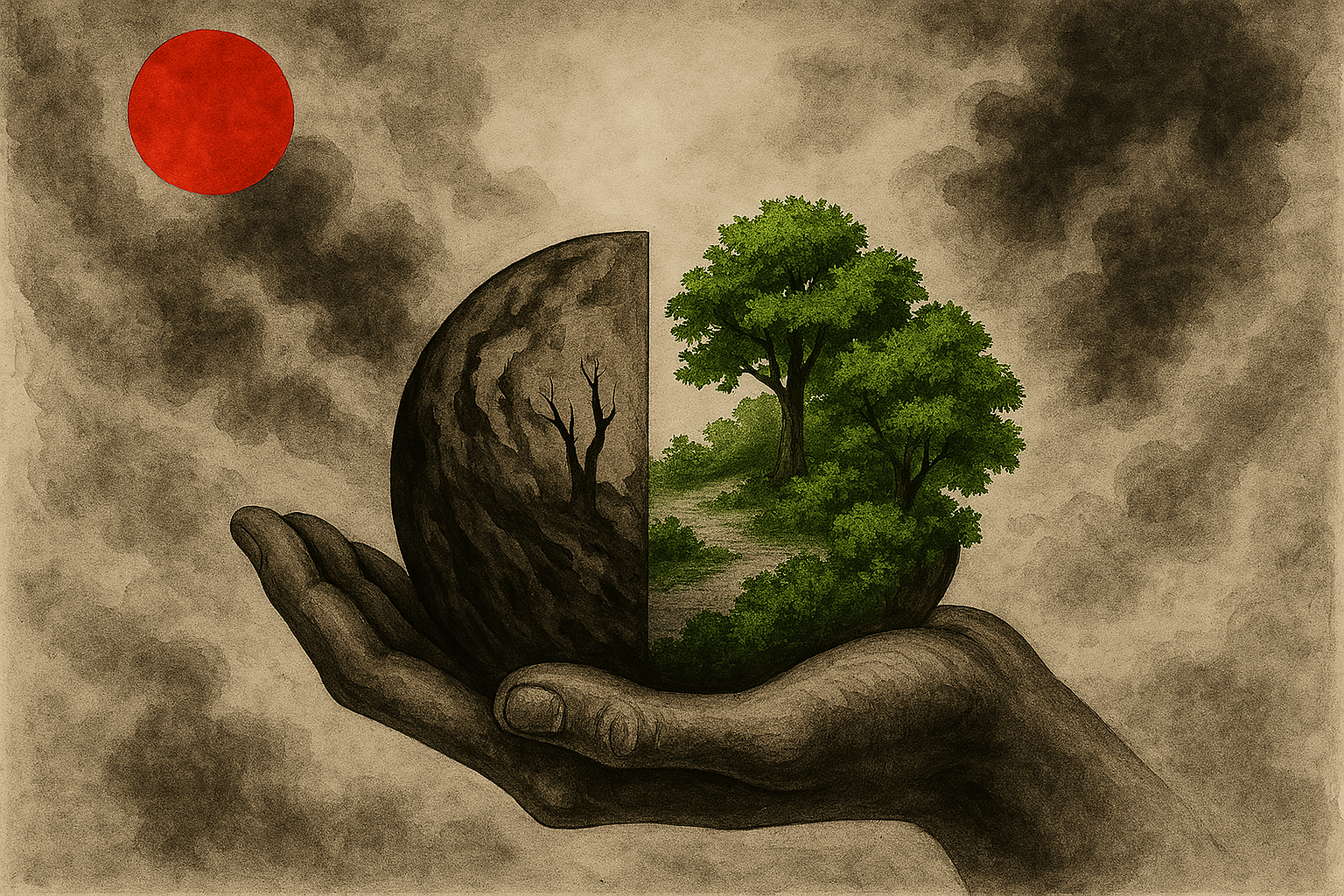
This has helped create a world in which economic growth and immediate interests can take precedence over the long-term health of the planet. Despite reaching extraordinary heights of technological capability in what is often called the “Anthropocene,” humanity has also inflicted deep wounds on the very systems upon which it depends.
Since 1990 alone, an estimated 420 million hectares of forest have been lost through deforestation.
Despite conservation efforts, species are disappearing at rates far above the long-term natural average.
Our oceans are accumulating plastics and microplastics while becoming increasingly acidic.
Water scarcity is intensifying across many parts of the world.
Topsoil is being lost far faster than it can naturally regenerate.
Even the space around Earth, once a symbol of limitless possibility, is increasingly crowded with human-made debris.
Are we really at the top of the food chain? Or are we simply acting like parasites on our own host?
Invention Without Regeneration
Our innovations can be dazzling, yet too often we think about what a product can do without giving equal attention to what comes before and after it: where its materials originate, how they are extracted, how long the product lasts, and what happens when it is discarded.
We celebrate innovators and businesses for creating products that improve our lives, while the environmental costs hidden across their entire life cycle can remain largely out of sight.
The electric-vehicle revolution offers a useful example. EVs can significantly reduce emissions compared with conventional cars, but that does not make them environmentally free. We should still be asking:
How are their batteries produced and eventually recycled?
Where and under what conditions are the critical minerals they require extracted?
Who and what bears the environmental and social costs of this “green” extraction?
The danger is not in pursuing cleaner technologies, but in mistaking improvement for a complete solution and if we celebrate only the benefit visible to us while pushing its costs elsewhere, we remain trapped in the same inside-out perspective.
Flipping the Pyramid: The Outside-In Vision
Most human systems today are designed in a way (Figure-1) where the individual is central, and concern for the larger world dissipates as you move outward but what if we flipped that order?
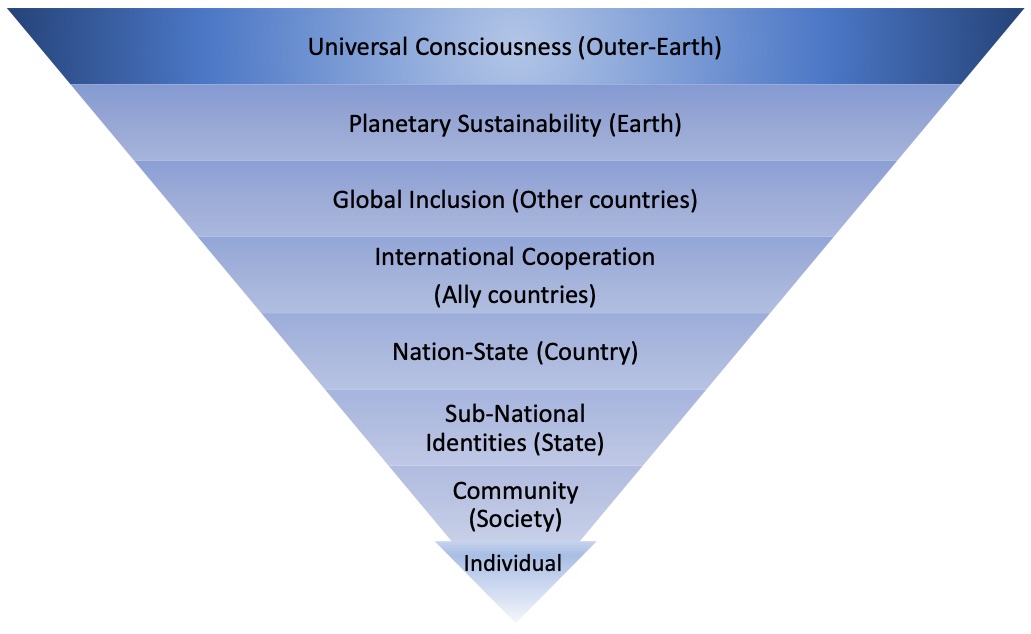
A reimagined priority structure that places universal consciousness and planetary well-being at the foundation of governance and individual action.
What if we embraced an outside-in model, one that begins with universal consciousness and planetary stewardship, and moves inward toward communities and finally, the self?
This is not a rejection of individuality or enterprise but a reordering of priority and not a negation of value.
It means:
Companies and countries can still make profits, but not by inflicting loss on others.
Progress can still be pursued, but not through ecological and ethical shortcuts.
Power can still be exercised, but only with deep responsibility to the collective future.
This can be seen as a purposeful orientation towards a successful survival.
What Must Be Realised
For such a transformation to occur, we must understand that:
The individual must not be the axis of civilisation.
Higher collectivism must be the reference point for institutions, policies, and ideologies.
Planet-first thinking must guide economy, technology, and governance.
And most crucially: this realisation must come from those already in power, the stewards of governments, corporations, and global institutions. I believe their vision must extend beyond borders, generations, and profit margins, profit must no longer be seen as a zero-sum contest, where one’s gain must come at another’s loss and nor should it be reduced to monetary surplus alone.
The fixation on endless growth, boundless accumulation, and billion-dollar thresholds has warped our sense of value.
Instead, we must begin to see profit as multidimensional:
A business that regenerates its ecosystem has profited.
A policy that uplifts the collective welfare without marginalising has profited.
A technology that replenishes resources has advanced progress.
This redefinition doesn’t mean businesses stop making money but it does mean accepting a new threshold of sufficiency and a profit of few millions can be meaningful but tens of billions may be unnecessary if it comes at the cost of planetary health and dignity of the sentient beings. This transformation is not a single event but a cultural and ethical evolution, a series of shifts in how we measure, reward, and aspire and it stems from flipping the pyramid of priorities: putting the greater whole above the individual ledger.
In this worldview, profit becomes shared well-being and not just private gain.
•••
Phase 03: The Great Implementation
If Phase 1 is about ideas and Phase 2 is about perspective, then Phase 3 is about architecture, on how we rebuild the institutional and leadership systems that govern this planet.
Reforming the Institutions: From Paper to Practice
Some of humanity’s most ambitious frameworks such as the United Nations began as luminous aspirations: to protect peace, prevent wars, end poverty, and give voice to every nation on Earth but today, these dreams exist largely on paper and the reality is more tragic: the United Nations has been hijacked by a handful of powerful states and reduced to a theatre of diplomacy, stalling beneath a collapsing scaffolding of veto paralysis, mandate constraints, resource starvation, and political cowardice. Let’s ask the obvious question:
How is it that out of over 190 countries, only 5 hold permanent power over the Security Council with veto rights that can kill any resolution, no matter how urgent, moral, or globally supported?
This is not representation but an institutional oligarchy.
What’s worse is that under the guise of humanitarian missions, entire economies and regions have been used as testing grounds for covert influence, resource extraction, and power projection yet noone is held accountable. We’ve seen:
- Different NGO operations turned into geopolitical theatre.
- Development funds filtered into phantom projects.
- Rogue actors operating illicit trade networks under “humanitarian cover”.
This is not conspiracy theory but unfortunately a reality known to anyone who’s looked beneath the polite surface of multilateralism.
The Need for a New UN Mandate
Perhaps the answer is not to abolish these institutions, but to ask how they might evolve.
Looking at the UN from the outside, several possibilities come to mind:
Rethinking the veto: Should any single country retain the power to override an overwhelming international consensus?
Broader representation: Could greater rotation of leadership and representation give different regions a more meaningful voice?
Greater regional understanding: Could peacekeeping, reconstruction, and humanitarian efforts benefit from stronger local and regional knowledge such as cultural, linguistic, and geographic?
Rethinking priorities: Are today’s institutions giving enough weight to climate, poverty, food and water security, and planetary health alongside traditional military and security concerns?
Greater transparency: Could stronger independent oversight, accessible data, and clearer accountability make international institutions more worthy of public trust?
Protecting humanitarian work: How can humanitarian aid, peacebuilding, and development remain focused on the people they are intended to serve, rather than becoming instruments of geopolitical or commercial interests?
None of these are simple reforms, nor are they without consequences of their own but they point toward a larger question: can the UN become more of a platform for shared human interests and less of an arena for zero-sum geopolitical competition?
And that question should perhaps extend beyond the UN to the wider network of international institutions that shape our collective future.
A Few Good Humans: The Leaders of the New Epoch
Every revolution in history has required people, not perfect people, but principled ones.
And if we are to rebuild governance for this planetary era, we must also rethink who leads, and how we select them.
The ancient Indian strategist Chanakya once outlined a test for leadership called ‘The Four-Fold Test”, to reveal a person’s (ministers and heads) true nature under four conditions:
Dharmopada (Test of Ethics)- Does this person uphold truth and justice when no one is watching?
Kamopada (Test of Desire)- How does this person behave when offered power, pleasure, or wealth?
Arthopada (Test of Gain)- Can this person handle resources and prosperity without becoming corrupt?
Bhayopada (Test of Fear)- Does this person stay true to their values when threatened or under pressure?
I am sure that finding such principled leaders among the many could not be that difficult and there must be few good humans who put personal gains and a tight community gains on the backseat while thinking of entire humanity as a potential that can be realised in ways much better than what we are doing right now. But for that to happen , at first the education system has to be reformed and we have to foster the right development and bring forth visionary leaders who can then reform their respective governments.
Conclusion: A Future Worth Voting For
So we return to the question : What is democracy truly for?
If its highest aim is merely to preserve order, protect markets, or rotate power among elites, then we have reached the limits of its usefulness but if democracy is to be more than performance and if it is to become a conscious architecture for human flourishing then we must reimagine it entirely. Not as a system perfected by history, but as a living ethic responsive to planetary reality.
In this reimagined vision, democracy is not defined by elections alone but by alignment of values, of priorities, of the self with the whole and it is where governance begins, not with ambition, but with humility, not with domination, but with stewardship and in this reimagined world, it is wisdom, not noise, that leads.