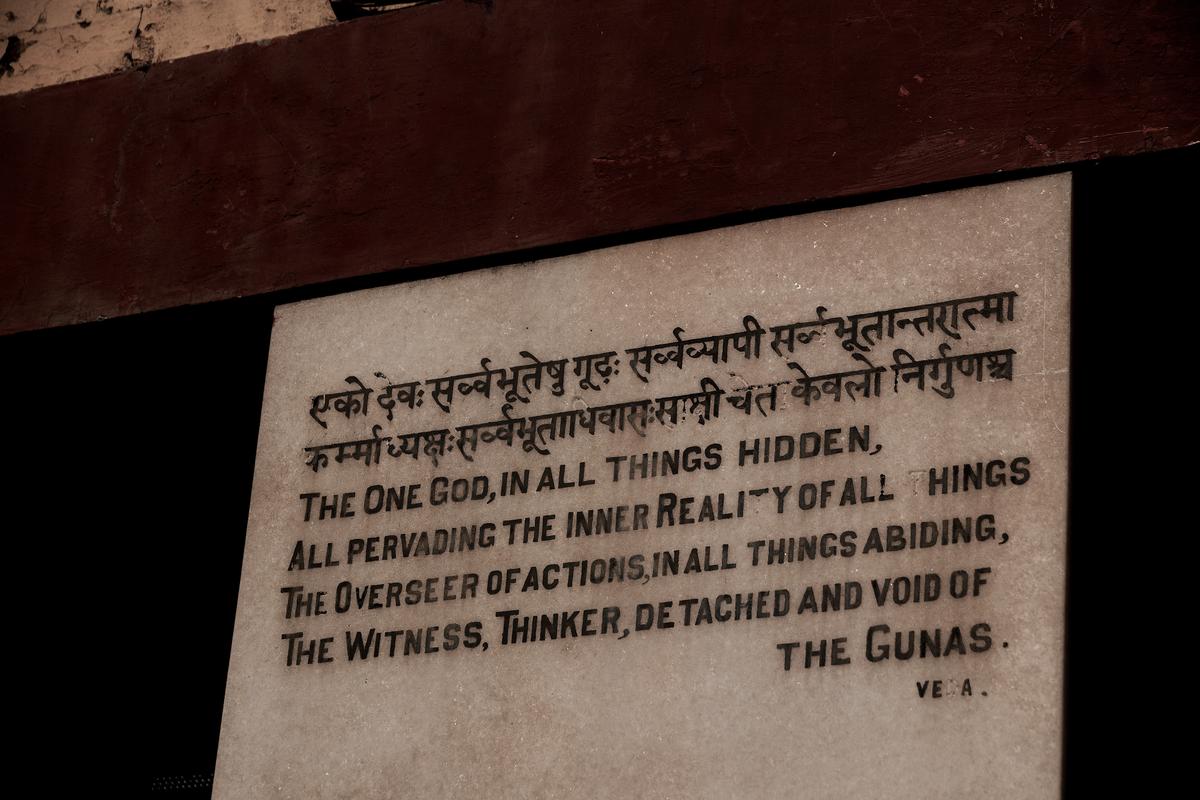
Image: Photo by Jan Dommerholt on Unsplash
At the heart of Advaita Vedanta, the ancient philosophy taught by the sage Shankaracharya, lies the profound concept of non-duality. His teachings, rooted in the Vedic tradition, offer an understanding of existence that transcends time and culture, though Shankara's insights are part of an ancient Indian spiritual tradition, thinkers from other parts of the world like Ibn Arabi, Meister Eckhart, and few others have arrived at remarkably similar realisations and despite the vast cultural and temporal distances, their reflections on the nature of existence converge on a singular, unifying truth.
•••
Singularity: The Core of Reality
To distill the essence of Advaita Vedanta into one concept, "Singularity" stands at the forefront. This singular entity has been called by many names throughout history: Turiya, Brahman, the Fourth and many more. While these terms may vary, they all point to the same fundamental truth: behind the apparent diversity and constant flux of the universe, there exists an unchanging, singular reality.
This foundational truth reveals that the world, though seemingly filled with multiplicity and change, is ultimately rooted in a unified essence. It is from this singular reality that everything arises, and to this same reality, everything returns. The world, the cosmos, and even our thoughts, seemingly distinct are interconnected at their core and this essence transcends birth and death, continuously giving rise to the appearance of all things, yet remaining beyond the reach of time and transformation.
The Nasadiya Sukta from the Rigveda, an ancient hymn, beautifully encapsulates this idea:
"Death was not then nor immortality,
Neither existence nor non-existence,
The night was not separate from the day,
At first, in darkness, hidden darkness lay."
In these profound lines, we hear the echoes of non-duality: a state of primordial unity, where distinctions such as life and death, existence and non-existence, are meaningless, this idea of singularity is not just a philosophical abstraction, but a reflection of the very fabric of reality.
From the grandest galaxies to the smallest thoughts in our minds, everything in existence is connected by the thread of this singularity, the world, in all its diversity, is not separate but is all part of a single, indivisible whole. Whether considering the movements of the planets or the development of life on Earth, the interconnectedness of all things becomes evident, for instance, the Moon's formation stabilised the Earth's axial tilt, enabling the conditions necessary for life to thrive, then tectonic plate movements shaped our continents, and the Cambrian Explosion sparked a dramatic increase in biodiversity. The same principle of interconnectedness can be observed in the rise of mammals, the impact of climate change, and the evolution of human beings.
Even the discovery and harnessing of fire, a transformative moment in human history, illustrates the web of interconnection that has shaped our development. This discovery enabled cognitive and social advancements, helping humans to survive and thrive and through each of these events, we see that everything, from the creation of life itself to the rise of human consciousness, is interconnected and part of a larger cosmic order. Modern science, particularly the Big Bang theory, supports this view where it suggests that all matter, energy, and even time itself originated from a single event, an origin that connects the entire cosmos in a profound and unified way. The cosmic beginning, the formation of stars and planets, the evolution of life, and the unfolding of human history, all share a common starting point and this universal truth aligns perfectly with the teachings of non-duality: nothing is separate, nothing is distinct and all things are part of the same singular whole.
•••
The Realisation of Oneness
Understanding this truth intellectually is not enough and true realisation of non-duality comes through direct experience. While the teachings of this tradition and other philosophical schools offer profound insights, the core message is not to merely study these texts but to experience the unity they describe and this truth must be realised within oneself, much like the act of tasting a dish reveals its flavour and it is not enough to know about the dish, one must taste it to understand its true nature.
When this realisation occurs, it brings about a profound transformation in the individual and a sense of the presence of the true self pervades everything, both the living and the non-living and the realisation of oneness opens the perception that all things are manifestations of the same singular reality. This transformative experience dissolves the boundaries between self and other, revealing the interconnectedness of all existence and if the moral foundation of societies were based on this understanding of oneness, the world would see greater unity and peace. At its core, non-duality reveals universal truths that are not confined to any one culture, religion, or tradition, instead, these insights speak to the common experience of humanity. Across cultures and epochs, the wisdom of non-duality provides a timeless framework for understanding the nature of existence.
The teachings of non-duality, whether found in the ancient texts or echoed in the words of mystics and philosophers worldwide, offer a vision for the future and by realising that all things are interconnected and part of the same singular truth, humanity can move toward a more harmonious existence. The ancient wisdom passed down through generations offers a foundation for a future rooted in unity, peace, and a deeper understanding of the true nature of reality.